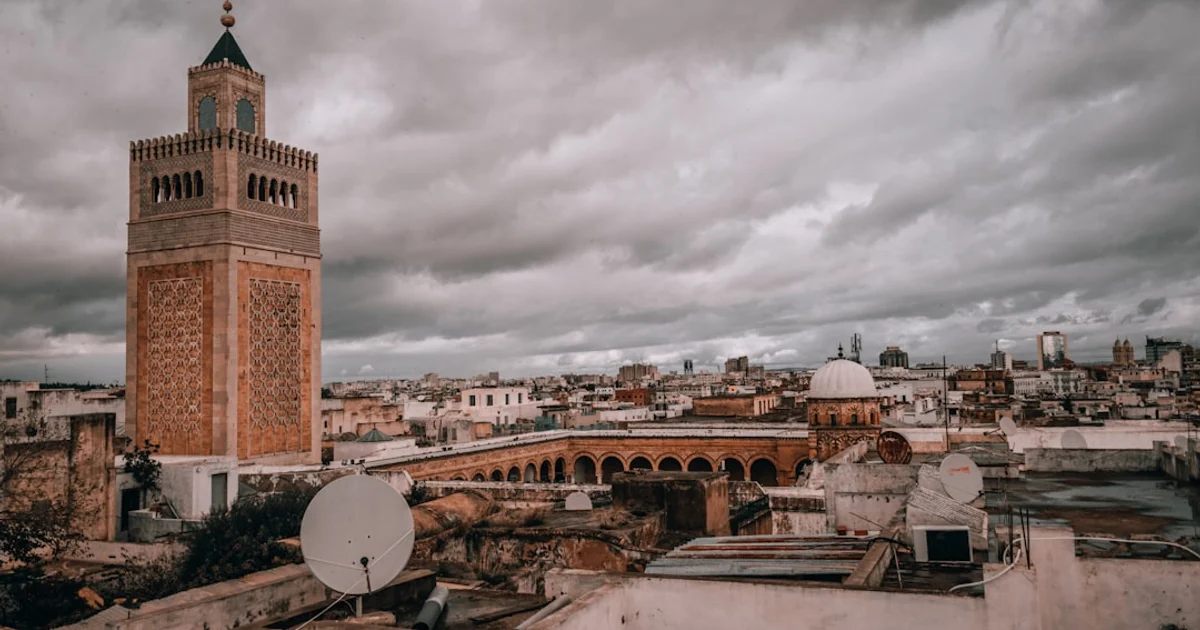
Every year the same question lands in diaspora forums, expat Facebook groups and Tunisian notary offices: can a foreigner actually buy a home in Tunisia? The short answer is yes. The longer answer involves a Governor’s signature, a special bank account and a stack of documents that trips up unprepared buyers. Between 2023 and 2025, dozens of purchases collapsed at the last minute, not because the buyer lacked money, but because nobody explained the rules before the deposit was paid.
Non-resident foreigners completed roughly 4,800 property transactions in Tunisia in 2025, according to figures from the Land Registry (Conservation de la Propriété Foncière). Greater Tunis, Hammamet, Sousse and Djerba absorbed about 78 percent of that demand. Buyers came from France, Italy, Germany and Canada, and increasingly from the Gulf. This guide walks through the legal framework, the authorisation, the money transfers, the fees and the areas where a foreigner realistically gets approved. All of it reflects the rules in force at the start of 2026.
What the Law Actually Allows
Tunisian property law draws a firm line between nationals and foreigners. A foreigner, whether an individual or a foreign company, may acquire property for residential, commercial or tourist use. That principle is settled. The exceptions matter just as much.
Agricultural land is completely off limits. There is no workaround, not even for a foreigner married to a Tunisian citizen. Military zones and some border areas are also excluded. What you can buy: apartments, villas, commercial premises and building plots inside residential or tourist zones. Each of those purchases still needs a prior authorisation from the Governor of the region, known locally as “el moafqa mta3 el wali.”
The Governor’s Authorisation
No sale to a foreigner can close without written approval from the Governor of the governorate where the property sits. This is the centrepiece of the file, and it is the slowest part.
Your notary files the request at the relevant governorate. The dossier includes your passport copy, the property’s land title, the signed sale agreement, a site plan, a municipal no-objection certificate and proof of where your funds come from. The governorate then routes the file to the security services and the Ministry of Defence for checks. That circuit explains the wait: budget two to six months. Tunis and Sousse clear files faster than Medenine or Jendouba, purely because of volume. One rule never to break: never sign a final deed before the authorisation arrives. The sale agreement must carry an explicit suspensive clause tied to it.
The Step by Step Process
The path from viewing to keys runs through eight stages. Skipping any of them tends to end badly.
- Find a titled property in a residential or tourist zone. Browse properties for sale in Tunisia on houni.tn to compare verified listings with location and price shown up front.
- Check the land title at the Land Registry. A registered “blue title” is essential. Older Arabic titles (moulkia) raise proof-of-ownership problems and add months.
- Sign the sale agreement at a notary, with a suspensive clause tied to the Governor’s authorisation. Usual deposit: 10 to 15 percent.
- File the authorisation request through your notary.
- Open a convertible dinar account at an approved Tunisian bank.
- Wire the funds into that account and collect the currency import certificate.
- Sign the final deed once the authorisation is granted.
- Register the property and pay the registration duties.
Moving Your Money In
The Central Bank of Tunisia requires non-resident foreigners to route every property payment through a special convertible dinar account. The mechanism does two jobs: it traces where the money came from, and it guarantees you can convert it back later.
You transfer euros, dollars or another convertible currency from your bank abroad. The Tunisian bank converts at the day’s rate and credits the convertible dinar account. For every wire, the bank issues a currency import certificate. That certificate is the legal proof your money originated abroad. Its real value shows up on resale: without it, the Central Bank blocks any outbound transfer of your sale proceeds. As the notaries put it, “mehech noss hedha,” it is not a paper you lose.
Fees You Will Pay
Purchase costs in Tunisia are the same for foreigners and nationals. Here is the breakdown for early 2026.
| Item | Rate / Amount | Basis |
|---|---|---|
| Registration duty | 5% | Declared price |
| Fiscal stamp | 1% | Declared price |
| Notary fees | 1–2% | Sale price (negotiable) |
| Land Registry filing | 150–300 TND | Flat |
| Currency import certificate | 0 TND | Free via bank |
| Mortgage registration (if financed) | 0.5% | Loan amount |
| Estimated total | 7.5–9% | Of sale price |
On a 400,000 TND apartment, expect 30,000 to 36,000 TND in costs. The 5 percent registration duty is the heaviest line. Buy off-plan from a licensed developer and that rate drops to 1 percent, a 16,000 TND saving on the same flat. Foreigners get no special exemptions here.
Understanding S+1, S+2 and S+3
Tunisian listings size apartments using an “S” code that confuses first-time foreign buyers. The “S” stands for “salon,” the living room, and the number counts the bedrooms alongside it. So an S+1 is a living room plus one bedroom, roughly a one-bedroom flat of 55 to 75 m2. An S+2 adds a second bedroom, typically 90 to 120 m2, the sweet spot for families and the most liquid resale segment. An S+3 runs 130 to 170 m2 and shades into villa territory in areas like La Soukra or Gammarth. Read the S code before the price, because a cheap S+3 in an outer suburb can cost less per square metre than a small S+1 on the Lac.
Where Foreigners Can Buy
Tunisia does not confine foreigners to fenced-off zones the way some Gulf states do. In practice, governorates approve files faster in developed tourist areas: Hammamet North and South, Sousse-Kantaoui, Djerba-Midoun, Tabarka and Gammarth. Residential districts of Greater Tunis (Les Berges du Lac, La Marsa, La Soukra, Ariana) are open too, provided the title is clean and the file is complete. Refusals cluster around military-adjacent plots, non-buildable land and properties with disputed status.
Start Your Search the Right Way
The buyers who succeed pick the property first, then build the financing and the authorisation around it. Choose a notary who has handled foreign files before, expect the Governor’s approval to set your timeline, and keep every currency certificate. When you are ready to shortlist, browse properties for sale in Tunisia on houni.tn and filter by governorate, price and property type so your first offer sits on solid ground.